
Patient access is where care begins. It is also where most practices lose revenue, patients, and staff without ever seeing it on a report.
When it works, patients get care quickly, staff stay in control of their day, and revenue isn’t lost in the gaps.
When it breaks, the costs add up in ways that rarely show on a single report: abandoned calls, scheduling errors, staff burnout, and patients who simply go somewhere else.
Most practices don’t have a clear way to see where they stand or what to fix in their patient access process. Changes happen reactively. A new phone system here. An online scheduling tool there. No clear picture of how the pieces connect or which investments will actually move the needle.
If it feels like improvements happen in fragments but never quite add up, you’re not imagining it.
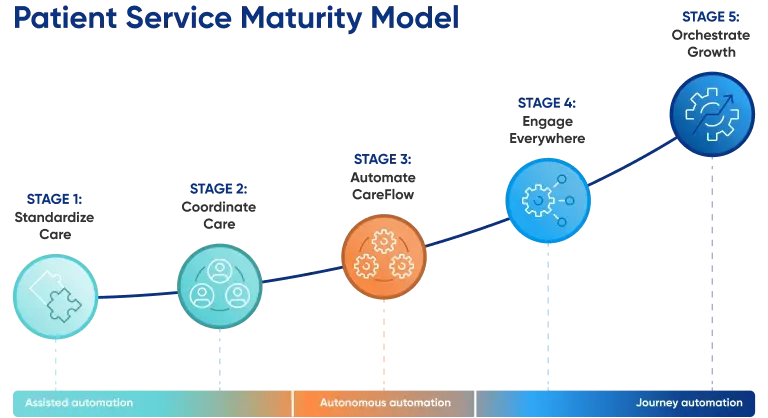
The Patient Service Maturity Model gives you that overview. It maps five stages of patient access maturity:
Each stage describes a distinct patient access operational profile, defining capabilities, typical challenges, and signals that demonstrate you’re ready for the next level.
There’s no fixed finish line. The framework gives you a way to see where you are today, understand what the next stage looks like, and make plans for how to get there.
Some practices move quickly through early stages and slow down as organizational complexity increases. Others find they’re operating at Stage 3 in some departments and Stage 1 in others.
Both are normal, and it is far better to know where you’re starting than to be guessing.
How We Turned the Challenge Into Results

Your practice has moved beyond the most reactive phase of patient access. You aren’t simply fielding calls without any structure. But at Stage 1, the structure doesn’t hold under pressure.
Scheduling procedures may be documented in a shared drive or a binder on the front desk, but they aren’t consistently followed across shifts. Training relies heavily on shadowing senior staff, which means new hires absorb habits (good and bad) rather than learning standards.
"The foundation: consistent workflows, documented protocols, and scheduling that doesn't depend on individual team member's memory."
The defining work of this stage is standardization itself: building the documented workflows and call-handling procedures that ensure every patient interaction meets a consistent baseline, regardless of who answers the phone. Provider templates are formalized. Call types are mapped to specific handling procedures. Performance starts being measured against clear targets, such as answer rate and average handling time.
You’re at this stage if your scheduling and tracking is based on call volume and not call outcomes. Your knowledge lives primarily in people’s heads, and your training process takes weeks of shadowing before a new hire can work independently.
If it feels like improvements happen in fragments but never quite add up, you’re not imagining it.
The Patient Service Maturity Model gives you that overview. It maps five stages of patient access maturity:
Read the Stage 1 deep dive: Why Consistency Is Harder Than It Looks

Stage 2 is where coordination starts reducing errors, rework, and friction across the organization.
At Stage 1, your call center handles calls well. At Stage 2, your call center handles calls well, while accounting for the complexity that other departments introduce: provider availability, room constraints, equipment scheduling, insurance requirements, and clinical safety protocols.
"Cross-departmental coordination: scheduling accounts for rules based on providers, rooms, equipment, payers, and clinical screening, all at the same time."
This is where first-contact resolution becomes a meaningful metric. Interactions resolve on the first attempt. Patients don’t have to call back because the scheduler didn’t have visibility into a payer rule or a provider preference. Departments that previously operated in silos (billing, clinical, front desk) begin contributing their rules and requirements into a shared workflow. The person answering the phone has what they need to complete the patient interaction without transferring, escalating, or calling back.
You’re at this stage if your scheduling accounts for multiple resources and constraints in real time. Clinical safety screening happens before every booking, and you’re actively measuring first-contact resolution and conversion rates, not just call volume.

At Stage 3, automation starts taking real work off your team’s plate.
Your practice has validated that AI can handle specific call types accurately and safely in an assisted mode, and it has begun delegating those call types to autonomous handling. Appointment confirmations, straightforward reschedules, and administrative calls during off-peak hours get resolved without staff involvement.
"AI handles validated interaction types autonomously, while your team focuses on complex patient requests."
At this stage, time shifts. Repetitive work drops away, and your team spends more time on interactions that require human judgment, clinical nuance, and relationship management. The scheduling coordinator who previously spent a third of the day confirming tomorrow’s appointments now spends that time resolving complex surgical coordination or handling sensitive patient concerns.
This stage also requires a system of record that preserves context across every channel and interaction. This system of record must be linked to patient context, know their clinical history, insurance status, and preferences. It needs to know your providers: their scheduling rules, equipment requirements, and clinical protocols. And it needs to know your practice: your workflows, your escalation logic, your site-specific constraints. When those three layers of intelligence are unified in a single platform, automation completes interactions accurately. Without it, automation creates a fragmented experience. Patients explain their situation to an AI, then start over when they reach a human. When complete context transfers with every interaction, handoffs between automated and human-guided workflows feel seamless to the patient and efficient for the staff.
You’re at this stage if AI is autonomously completing specific, validated interaction types. Your staff are spending measurably more time on complex cases, and context is preserved across every handoff between automated and human-guided interactions.

By Stage 4, most practices offer multiple channels. The difference is whether those channels share the same intelligence.
A portal that lets patients self-schedule follow-up visits but can’t enforce payer rules isn’t omnichannel engagement; it’s a convenience tool that creates downstream rework. True omnichannel means clinical rules, provider preferences, and scheduling constraints are embedded in every digital touchpoint. Patients get the same quality of coordination whether they call, text, book online, or message through the portal.
"Every channel (phone, web, text, portal) shares the same clinical intelligence and scheduling rules."
At this stage, online self-scheduling converts at meaningfully higher rates because the booking experience enforces the same rules your phone team follows. Patients don’t encounter dead ends where they select a visit type, choose a time, and then get a callback explaining the appointment won’t work. SMS and messaging channels handle appointment management (confirmations, reschedules, pre-visit instructions) without requiring staff involvement for interactions that don’t need clinical judgment.
You’re at this stage if patients complete interactions across multiple channels without losing context or encountering inconsistent rules. Your online scheduling enforces the same constraints your phone team follows, and your channel mix data shows meaningful volume shifting to self-service without increasing error rates.

Stage 5 is where patient access starts driving measurable growth.
The intelligence your practice has accumulated across the previous four stages (patient patterns, scheduling data, provider utilization, channel preferences) becomes the foundation for proactive operations. Practices that treat this intelligence as a strategic asset can act on it. Those running disconnected point solutions have data in every system and insight in none.
"Patient access intelligence drives practice growth through proactive outreach, care gap management, and schedule optimization."
Instead of waiting for patients to call, your systems identify patients due for follow-up care, manage recall programs, fill cancellation slots automatically, and flag care gaps in real time.
At this stage, marketing, patient service, and financial operations are able to work in harmony. When these functions share the same operational intelligence, your practice can track the full patient journey from initial contact to completed visit. You can measure the true return on outreach campaigns based on appointments completed rather than messages sent, and you can optimize provider schedules based on predicted demand rather than historical averages.
You’re at this stage if your patient access operations proactively drive appointments rather than waiting for inbound volume. Your schedule utilization is consistently optimized through predictive intelligence, and you can trace the connection between outreach efforts and completed patient visits.
Navigating Between Stages
The maturity path isn’t always linear.
Most practices don’t advance cleanly through the stages across every functional area at the same time. You might have scheduling running at Stage 3 while after-hours sits at Stage 1. Or primary care coordinating beautifully at Stage 2 while surgical scheduling operates as an island.
Knowing you have unevenness is useful information.
It tells you where the gaps are, where the next investment will have the most impact, and where quick wins can build momentum.
The framework’s value lies in giving you a common vocabulary for conversations about where you are and where you’re headed.
A few patterns show up consistently.
Moving from Stage 1 to Stage 2 is an organizational challenge. It depends on cross-departmental alignment that many practices haven’t formalized.
Moving from Stage 2 to Stage 3 is a trust and technology shift. Your team needs confidence that automation will maintain quality.
Moving beyond Stage 3 becomes strategic. Patient access starts being treated as a competitive advantage rather than an operational expense.
Measuring Your Patient Access Maturity
Each stage has defining metrics that signal where your practice currently operates.
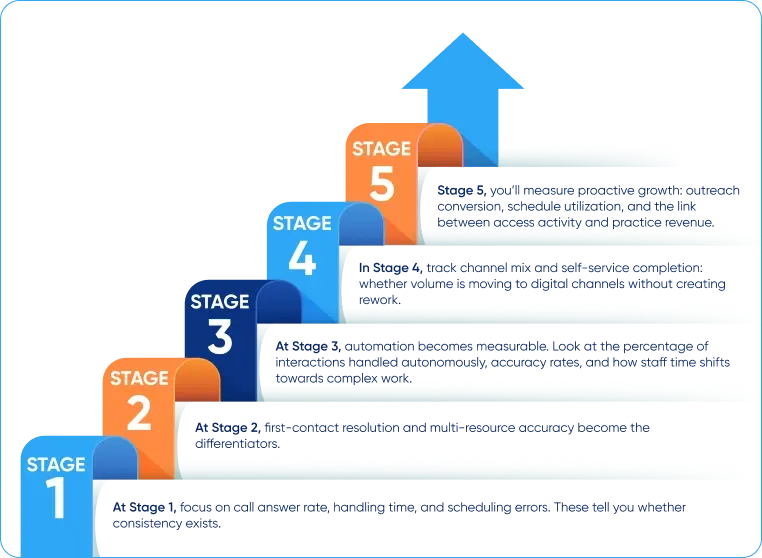
Two metrics will tell you almost everything you need to know:
What percentage of your calls meet the healthcare contact-center service-level benchmark of answering 80% of calls within 30 seconds?
What percentage of patient interactions resolve on the first contact? (Healthcare’s industry average sits around 52%; strong performers reach 70 to 75%.)
Those two numbers alone will tell you whether your next priority is standardization or coordination.

Find Your Stage
We’ve created a Visual Guide to the 5 Stages of Patient Access Maturity that maps the full framework on a single page. Use it to pinpoint your current stage and align your team on what needs to change next.
We’ve Created a Visual Guide to the 5 Stages of Patient Access Maturity
Each stage has its own deep dive, practical guides for the transitions between them, and real-world examples from practices that have advanced through the model.
We are creating a comprehensive resource for patient access leaders who are serious about measuring and improving their operations systematically.
About the Framework
The Patient Service Maturity Model was developed by Keona Health based on more than a decade of patient access operations experience across orthopedics, urology, women's health, pediatrics, and primary care. The five stages reflect operational patterns that appear consistently, regardless of specialty or practice size.
Frequently Asked Questions About Patient Access Maturity
Framework Discovery
Is there a maturity model for patient access in healthcare?
Yes. The Patient Service Maturity Model (PSMM) is a five-stage framework designed specifically for patient access operations, including scheduling, triage, service coordination, and after-hours coverage. Unlike broader healthcare IT maturity models focused on EHR adoption or digital health communication, the PSMM addresses the operational workflows that determine whether your patients actually get the care they need. The five stages are outlined in the framework overview above.
How do I assess my practice's patient access maturity?
Read through each of the five stages above and identify where your operations fit. Most practices sit at different stages across different functions. You might be at Stage 3 in scheduling but Stage 1 in after-hours coverage, and that's normal. The Visual Guide PDF provides a one-page reference to share with your team, and a self-assessment tool is coming later this year.
What are the five stages of patient access maturity?
Stage 1: Standardize Care (documented workflows and consistent call handling). Stage 2: Coordinate Care (cross-departmental scheduling and clinical safety screening). Stage 3: Automate CareFlow (AI handling validated call types autonomously). Stage 4: Engage Everywhere (omnichannel access with consistent clinical rules). Stage 5: Orchestrate Growth (proactive outreach, care gap management, and schedule optimization at scale).
Operational Challenges
How do I reduce call abandonment in my medical practice?
Your missed calls (abandonment rate) improve when you align staffing with demand patterns (Stage 1) and build first-contact resolution into your workflows (Stage 2). When your team resolves a patient's need on the first call without transfers or callbacks, hold times drop and fewer patients hang up. The Stage 1 and Stage 2 sections above describe what these capabilities look like in practice.
How do I improve patient scheduling efficiency?
Scheduling efficiency is a progression, and where you start depends on where you are today. Stage 1 focuses on consistent procedures and documented templates. Stage 2 adds cross-departmental coordination and payer rules. Stage 3 introduces AI for validated call types, freeing your staff to focus on complex scheduling. Each stage in the framework maps to specific scheduling capabilities you can measure against.
What is the ROI of improving patient access operations?
ROI follows a consistent pattern across stages: fewer missed calls (abandonment rate), higher solve-on-first-call rates (First Call Resolution, or FCR), lower cost per interaction, and improved patient satisfaction. The metrics section above maps the defining measurements to each stage. Detailed ROI data for specific improvements will be published in the stage-specific deep dives throughout this series.
How do I implement AI in my healthcare call center?
The PSMM positions AI implementation at Stage 3 (Automate CareFlow), but it requires Stage 2's coordination foundation first. If you layer AI onto undocumented workflows, you create expensive problems rather than solving them. The Stage 3 section above describes what validated, sustainable AI deployment looks like in your patient access operation.
Evaluating Approaches
What should a patient scheduling solution include?
That depends on your maturity stage. At Stage 1, you need a phone system with call statistics and documented procedures. At Stage 2, you need unified multi-resource scheduling tools. Stage 3 requires a Healthcare CRM foundation for AI automation. Stage 4 adds omnichannel self-scheduling with clinical rules built in. The framework gives you the evaluation lens for matching solutions to your readiness.
How do I compare patient access vendors?
Use the maturity framework as your evaluation structure. Identify your current stage, define the stage you're building toward, and ask each vendor which stages their solution serves. A vendor promising Stage 4 capabilities won't deliver results if you haven't completed the Stage 2 coordination work those capabilities depend on.
What is the difference between patient access and patient engagement?
Patient access is the operational domain: scheduling, triage, service coordination, after-hours coverage, and the workflows that determine whether your patients reach and receive care. Patient engagement is the communication domain: portal adoption, messaging, and wellness outreach. The PSMM focuses on access operations. The two domains are complementary but distinct.
Building Your Path Forward
How do I move from manual scheduling to AI-assisted scheduling?
The PSMM maps this as a three-stage journey. Stage 1 standardizes your workflows. Stage 2 coordinates them across departments and integrates clinical safety rules. Stage 3 introduces AI for validated call types. Skipping directly from manual to AI typically creates more problems than it solves, because the AI has no documented logic to follow.
What metrics should I track for patient access performance?
Stage 1: call answer rates and speed of answer. Stage 2: first-contact resolution and scheduling accuracy. Stage 3: AI completion rates. Stage 4: channel distribution and online scheduling conversion. Stage 5: appointment slot fill rate (schedule utilization) and care gap closure rates. The metrics section above provides the full progression.
How do I build a business case for patient access technology?
Understanding where you sit on the maturity curve is the first step. The gaps between your current operations and the next stage are where the business case lives. The Visual Guide PDF provides a shareable one-page summary to align your leadership team on where you stand and where the investment opportunity is.
Ready to see where your practice stands? Download the Visual Guide to map your current stage and identify your next move.