

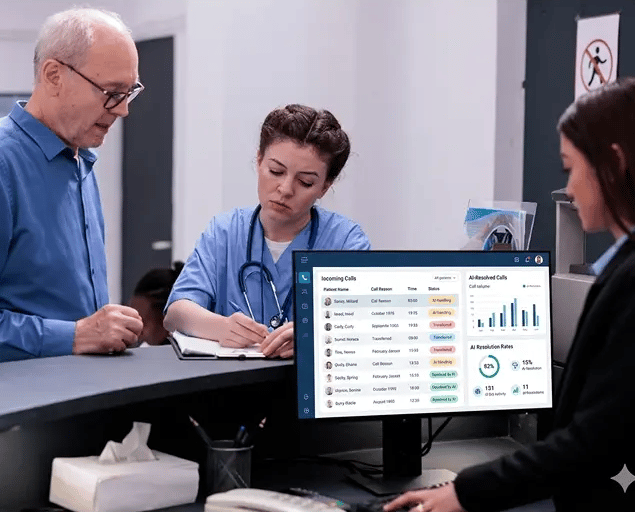

Before
Before Image
After
After Image

Real Practices

Why Calls Break Down in Real Practices

Patients call with straightforward needs that aren’t answered.
Voicemails stack up, and staff spend their time calling people back instead of helping the person who’s actually on the line.

The problem isn’t effort. It’s that every call is treated the same.

cross
Patients give up and book elsewhere
cross
Staff juggle callbacks and live calls at the same time
cross
Urgent issues arrive mixed in with straightforward requests

What Changes When Calls Get Completed

Calls stop restarting. Patients get answers. Staff gets relief.

True Icon
Repetitive requests get handled immediately

Most appointment changes, refills, and common questions are completed on the first interaction without staff involvement. Patients don’t wait. Staff don’t call back. Volume drops without deflection tactics.

True Icon
Complex calls reach the right person with context

Symptoms, history, and intent are captured before handoff. Staff start the call informed instead of interrogating.

True Icon
Your team spends time on judgment, not sorting

Fewer interruptions. Fewer angry callers. Fewer end-of-day cleanups. Workdays become predictable again.

How CareDesk Works With Your System

How CareDesk Works With Your System
Group (5)-1
01

Compatible with your current EHR and phone setup

No IT nightmares or ripping out technology. Go live in 2–4 weeks.

Group (5)-1
02

Your practice rules are built in automatically

Staff no longer need to memorize the scheduling manual: the system enforces the rules automatically. Training time drops from weeks to days in most workflows (see case study below).

Group (5)-1
03

Calls are answered instantly, with completed resolution or warm handoff with full context

Straightforward calls are completed automatically. Full clinical context is captured before handoff, so staff focus on patients needing expertise.

Frame 2087326232
The challenge:

High call volume and complex orthopedic scheduling overwhelmed access staff

The result:
125%

increase in calls handled per agent after implementation.

Never heard of agents trained and taking calls without error in 2 days. That’s what happened to us within 2 weeks!

Jordan Sappington
Operations Director

Why CareDesk Works Where Other Tools Don’t 

Built for healthcare’s reality, not adapted from generic call centers

 We spent 13 years learning healthcare's complexity. Clinical decisions, provider preferences, patient safety—built in from day one, not bolted on after. 

Designed to complete care, not deflect it

CareDesk answers calls instantly and routes them appropriately. Large share of repetitive volume completed automatically, with staff guided through complex cases using your rules.

Supports staff instead of replacing them

Your staff doesn't lose their jobs—they stop drowning in repetitive calls and focus on patients who need their expertise. Teams report lower burnout and faster onboarding.

 Works With Your Current Systems 

Group 13980
image 91 copy 1 (1)
image 88
Group 13978 1
Rectangle (1)
allscripts-vector-logo 3
Group 13981
image 88

Frequently Asked Questions

 See How Calls Get Completed 
 Calculate my call recovery potential 

What does this actually cost vs. hiring another person?

Most practices recover the investment in 3-6 months through stopped revenue leakage (abandoned calls ~ $247 each, scheduling errors, new patient conversion). Typically costs less than one full-time employee—but supports the work of 2-3 people in high-volume access roles. We can show specific numbers for your practice.

Will my staff resist this? They're already overwhelmed with changes.

Staff love it because it removes chaos. They stop memorizing 170-page manuals and getting blamed for scheduling errors. The system guides them—they focus on patient care. Staff retention actually improves. 

Do we need to hire IT people? Our current systems barely work.

No IT team needed. We connect to your existing EHR (Athena, Epic, etc.) and phone system. Most practices go live in 2-4 weeks with our team handling the technical work. You focus on medicine.

What if we're too small? We only have 8-15 providers.

Perfect size. Smaller practices see the fastest ROI because every avoided error and prevented staff quit has immediate impact. We designed this specifically for practices with 8-50 providers.